Understanding heavy-duty rack load capacity is essential for safe, efficient, and compliant warehouse storage in Malaysia. The load capacity of a rack is not just a number on a specification sheet. It reflects how much weight each beam, level, and frame can support under actual operating conditions.
A well-designed heavy-duty warehouse rack balances pallet weight, SKU flow, forklift handling, and safety considerations. Mismatches between load capacity and real warehouse demands can lead to structural failures, inventory damage, injuries, and costly downtime. By understanding load capacity, the meaning of UDL, and how pallet weight affects rack selection, warehouse operators can make better planning decisions that enhance both safety and efficiency.
What UDL Means in Warehouse Racking
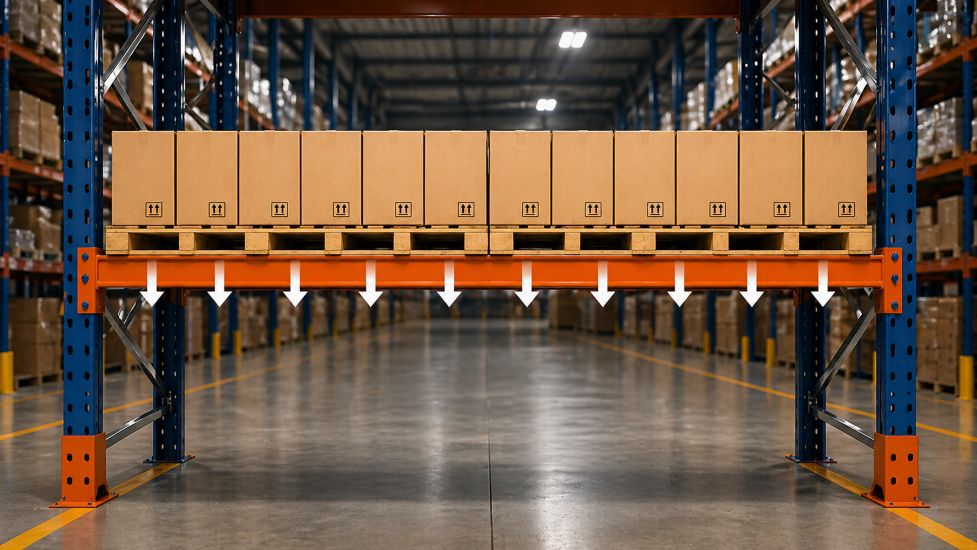
In warehouse racking, load ratings are often expressed as UDL, or Uniformly Distributed Load. This indicates the maximum weight a beam or rack level can safely support when weight is evenly distributed.
UDL is central to warehouse rack load calculation because it provides a realistic basis for estimating how much weight a beam or frame can carry under normal use. For example, a beam rated for 3,000 kilograms UDL per level means that the level is designed to carry that weight when pallets are placed to distribute the load evenly.
UDL matters because it reflects real-world usage, simplifies planning, and helps prevent structural failures. Racks are engineered with safety factors to resist bending and deflection under rated loads. Malaysian suppliers typically publish UDL load tables for different beam lengths and upright configurations to assist warehouse planners.
How Pallet Weight Affects Rack Selection
Pallet weight is a critical factor in selecting the right rack. Heavy pallets apply forces that the rack must be engineered to resist. Operators should:
- Identify the heaviest expected pallet, including packaging and load variance
- Add a safety buffer of 10 to 15 per cent to account for forklift handling impacts
- Compare the total weight with the manufacturer’s load tables
For Malaysian warehouse operations handling pallets from 500 to over 1,500 kilograms each, total vertical and horizontal loads must be carefully calculated. Heavy-duty racks must account for beam deflection, upright compression, and dynamic impact loads from forklifts. Incorrect assumptions about pallet weight can compromise the load capacity of heavy-duty racks and warehouse safety.
Practical Load-Calculation Example
Beam Length | Pallet Size | Pallet Weight | Number of Pallets | Total Weight | UDL Check |
2.5 m | 1.2 x 1.0 m | 1000 kg | 2 | 2000 kg | Safe (UDL = 2500 kg) |
2.5 m | 1.2 x 1.0 m | 1200 kg | 2 | 2400 kg | Safe (UDL = 2500 kg) |
2.5 m | 1.2 x 1.0 m | 1500 kg | 2 | 3000 kg | Exceeds UDL – Upgrade Beam |
Explanation:
- Total weight is calculated by multiplying pallet weight by the number of pallets per beam.
- Compare this to the UDL rating of the beam.
- If the total weight exceeds UDL, the beam must be upgraded or pallets redistributed.
Why SKU Flow and Picking Frequency Matter
Static load ratings do not capture the dynamic forces from everyday warehouse operations. SKU flow, or how pallets move in and out, affects rack performance. High SKU turnover, frequent picking, and constant pallet movement introduce additional stresses on beams and connectors.
Considerations include:
- Frequency of pallet movement
- Staging versus long-term storage
- Weight variance by SKU
High-turnover operations benefit from selective racks for direct access, while low-turnover, heavy-pallet storage may use double-deep or VNA systems to maximise density. Aligning SKU flow with pallet weight ensures racks support both static and dynamic loads efficiently.
Common Load-Planning Mistakes
Even experienced warehouse teams can make errors. Common mistakes include:
- Ignoring concentrated loads and assuming UDL is sufficient
- Underestimating pallet weight variance
- Neglecting forklift reach and impact forces
- Underestimating future SKU growth
- Choosing racks based on price rather than operational fit
Avoiding these mistakes reduces risk to personnel and inventory, ensuring racks perform as intended over time.
When Selective, Double Deep, or VNA Makes More Sense
Different racking configurations influence storage density, access, and load management.
Selective Pallet Racking provides direct access to every pallet, making load calculations straightforward. It is ideal for frequent picking, many SKUs, and standard forklift use.
Double Deep Racking holds two pallets deep, increasing storage density but requiring careful load balance and deep-reach forklifts. Load planning must account for both front- and rear-pallet weights.
VNA Racking maximises floor space and height with very narrow aisles and specialised forklifts. Load capacity and handling strategy must be carefully considered. VNA is increasingly popular in Malaysian warehouses where space is limited.
Load Calculation for Dynamic Operations
Factor | Static Load | Dynamic Load | Notes |
Pallet weight | 1000 kg | 1000 kg | Static weight at rest |
Forklift impact factor | – | 1.10 | Accounts for minor handling impacts |
Safety factor | 1.0 | 1.25 | 25% margin is standard in Malaysia |
Calculation:
Dynamic load = Pallet Weight × Impact Factor × Safety Factor
Example: 1000 × 1.10 × 1.25 = 1375 kg per pallet dynamic load
This approach helps operators select beams and uprights that safely support both static and moving loads.
Why Professional Rack Design Matters
Professional rack design integrates engineering, operations, and safety. Structural engineers evaluate UDL, beam deflection, and upright strength. Planners align pallet weight with SKU flow and forklift access. Safety experts ensure compliance with local building codes. Professional design ensures heavy-duty rack load capacity matches operational realities rather than generic product specs.
Final Thoughts
There is no universal best racking system for every warehouse. The right choice depends on how well pallet weight, SKU flow, and handling equipment align with the load capacity and operational workflow.
Selective racking is suited for varied SKU profiles and frequent access. Double deep increases density with moderate access. VNA maximises height and space but requires specialised equipment. Drive-in racking offers high density for bulk pallets with low SKU variety.
Adopting a load-capacity strategy that integrates pallet weight, UDL considerations, warehouse flow, and safety factors is essential for long-term operational success. If you need help designing a heavy-duty rack system that fits your warehouse layout, pallet profile, and SKU flow, talk to EMTS today.
Frequently Asked Questions
Which racking system is best for high-turnover inventory?
Selective pallet racking is ideal for direct access to many SKUs.
How much weight can a heavy-duty rack hold?
It depends on UDL and concentrated load ratings. Use manufacturer tables and safety margins.
Do double deep racks need special forklifts?
Yes, rear pallets require deep-reach forklifts or attachments.
Can VNA racks support heavy pallets?
Yes, with rated beams, uprights, and specialised forklifts.
What is the difference between UDL and concentrated load?
UDL assumes even distribution; a concentrated load is a weight focused in one area. Both must be considered when planning rack load capacity because a rack that is safe under evenly distributed weight may still be overstressed if heavy pallets or loads are placed unevenly on one section of the beam.