Choosing retail fixtures is not just about finding shelves to place products on. The right fixture affects how customers move through your store, how easily they find products, and how well your products are displayed.
For minimarts, supermarkets, pharmacies, hardware stores, and retail outlets, fixture planning can make a big difference. A poorly planned layout may create narrow aisles, hidden products, messy categories, or underused floor space. A well-planned layout can improve shopper flow, product visibility, and overall store organisation.
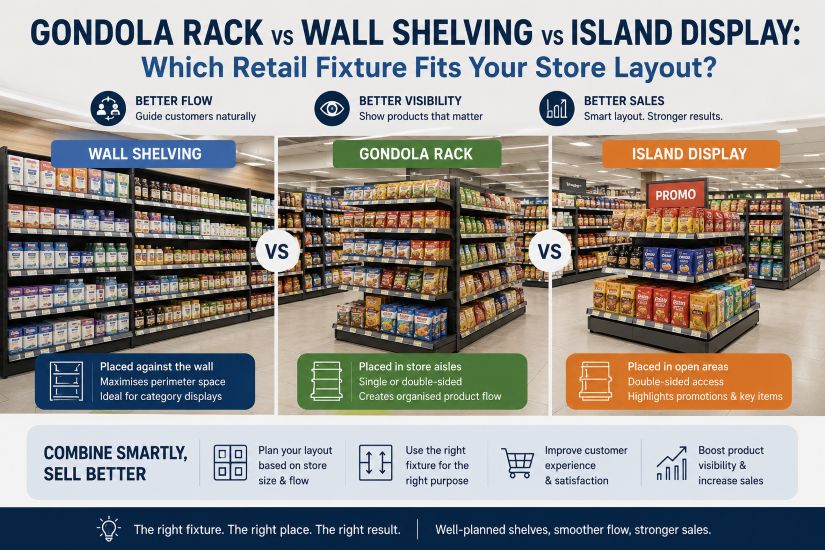
Three common retail fixture options are gondola racks, wall shelving, and island displays. Each one has a different function. Wall shelving helps maximise perimeter space, gondola racks help create organised aisles, and island displays help highlight products in open floor areas.
If you are planning a retail store layout, understanding these differences can help you choose the right shelving setup before buying your fixtures.
Why Retail Fixture Choice Shapes Store Flow
Retail fixtures influence how customers move, browse, and interact with products.
When racks are placed properly, customers can move through the store naturally. Product categories become easier to understand, promotional items become more visible, and shoppers can browse without feeling blocked or confused.
However, poor fixture planning can create several problems. Aisles may become too narrow. Tall racks may block visibility. Products may be placed in areas where customers do not notice them. Promotional displays may interrupt movement rather than encourage browsing.
Good retail fixture planning should consider:
- Store size
- Aisle width
- Customer flow
- Product category
- Product weight
- Product height
- Stock volume
- Visibility from entrances
- Checkout flow
- Promotional areas
- Future expansion
This is why the choice between wall shelving, gondola racks, and island displays should be made based on store layout, not only price or appearance.
What Is a Gondola Rack?
A gondola rack is a freestanding retail shelving fixture commonly used in supermarkets, minimarts, pharmacies, convenience stores, hardware stores, bookstores, and general retail shops.
It is usually placed in the centre area of a store to create aisles and display products in an organised way. Depending on the design, a gondola rack can be single-sided or double-sided.
Gondola racks are popular because they are practical, modular, and adjustable. Shelves can usually be repositioned to suit different product heights, packaging sizes, and display needs.
A gondola rack is commonly used for:
- Snacks
- Groceries
- Household products
- Pharmacy items
- Beauty and personal care products
- Hardware accessories
- Stationery
- Packaged goods
- Retail merchandise
- Promotional products
For store owners, gondola racks are useful because they help divide the retail floor into clear product zones. Instead of placing products randomly, retailers can create organised aisles that guide customers through the store.
What Is Wall Shelving Best Used For?
Wall shelving is placed against the perimeter wall of a store. It is usually single-sided, meaning customers browse products from the front only.
This type of shelving is useful because it helps maximise wall space without taking up too much floor area. For smaller stores, wall shelving can be especially valuable because it allows products to be displayed vertically along the edges of the store.
Wall shelving is commonly used for:
- Perimeter product displays
- Back-wall categories
- Pharmacy products
- Grocery items
- Hardware tools and accessories
- Household items
- Beauty and personal care products
- Packaged goods
- Products that need clear category arrangement
Wall shelving is also useful for products that customers expect to find along the edges of the store. For example, a pharmacy may place personal care or healthcare categories along wall shelves, while a hardware store may use wall shelving for tools, accessories, and larger packaged items.
The main advantage of wall shelving is space efficiency. It keeps the centre of the store open for gondola racks, island displays, or customer movement.
What Does an Island Display Do Differently?
An island display is usually placed in the open centre area of a store. It is often double-sided, allowing customers to browse products from more than one side.
Island displays are useful when retailers want to create high-visibility product zones. They are commonly used for promotions, seasonal items, fast-moving goods, new arrivals, and products that should attract attention.
An island display can be used for:
- Promotional products
- Seasonal campaigns
- Fast-moving items
- Impulse-buy products
- Featured brands
- New arrivals
- Event or festive displays
- High-margin products
- Clearance items
Unlike wall shelving, which sits against the perimeter, island displays are designed to stand out in the customer’s path. They can help guide movement through the store while giving certain products stronger visibility.
However, island displays must be placed carefully. If they are too large or placed in the wrong area, they can block movement and make the store feel crowded.
Gondola Rack vs Wall Shelving vs Island Display: Key Differences
Each retail fixture has a different role in store layout planning.
|
Factor |
Wall Shelving |
Gondola Rack |
Island Display |
|
Placement |
Against walls |
Centre aisles or retail floor |
Open centre floor areas |
|
Display Sides |
Usually one side |
Single or double-sided |
Usually double-sided |
|
Best For |
Perimeter display |
Main product aisles |
Promotions and high-visibility products |
|
Space Use |
Saves floor space |
Creates organised aisles |
Uses open floor space |
|
Shopper Access |
Front-facing only |
One or both sides |
Multiple sides depending on design |
|
Product Visibility |
Good for wall categories |
Good for structured categories |
Strong for featured products |
|
Common Users |
Minimarts, pharmacies, hardware stores |
Supermarkets, minimarts, retail stores |
Supermarkets, promotions, seasonal displays |
The best fixture depends on what you want the space to do. If you want to use wall space efficiently, wall shelving is a useful option. If you want to create structured aisles, gondola racks are a suitable option. If you want to highlight products in high-traffic areas, island displays can help.
Which Fixture Suits Different Store Types?
Different retail businesses need different shelving layouts. The best fixture choice depends on product type, store size, and shopper behaviour.
Minimarts
Minimarts usually need compact shelving and clear aisles. Since space is often limited, every fixture must be placed carefully.
Wall shelving works well around the perimeter because it helps maximise the edges of the store. Gondola racks can then be used in the centre to create aisles for snacks, drinks, groceries, household items, and daily essentials.
For minimarts, the best layout usually combines:
- Wall shelving for perimeter products
- Gondola racks for centre aisles
- Small island displays for promotions
- Checkout display racks for impulse-buy items
The key is to keep the layout easy to walk through. If too many fixtures are placed in a small space, customers may feel uncomfortable browsing.
Supermarkets
Supermarkets usually need more shelving capacity and stronger category zoning. Since supermarkets carry many product types, gondola racks are useful for creating structured aisles.
Wall shelving can be used for perimeter categories, while island displays can support promotional campaigns, seasonal products, and high-visibility items.
A supermarket layout may use:
- Long gondola rack aisles for dry goods and packaged items
- Wall shelving for larger categories or perimeter displays
- Island displays for festive campaigns and promotions
- End displays for special offers or impulse-buy products
For supermarkets, fixture planning should consider customer flow from entrance to checkout. Popular categories should be easy to find, while promotional zones should be placed where they can attract attention without blocking movement.
Pharmacies
Pharmacies need clean, organised, and easy-to-browse shelving. Customers often look for specific product categories, so clear arrangement is important.
Wall shelving can be used for healthcare, beauty, personal care, supplements, and wellness products. Gondola racks can support aisle-based shopping for smaller retail categories.
Pharmacies may benefit from fixtures that are not too tall, especially if the store needs good visibility across the space. Clear sightlines help staff monitor the store and help customers feel less overwhelmed.
A pharmacy layout may include:
- Wall shelving for main categories
- Gondola racks for smaller retail products
- Lower display units for visibility
- Counter displays for small items near checkout
Hardware Stores
Hardware stores often carry heavier and more varied products, so fixture strength is very important.
Wall shelving can be useful for heavier items, tools, equipment, and larger packaged products. Gondola racks can display smaller tools, accessories, paints, screws, tapes, electrical items, and general hardware products.
For hardware stores, fixture planning should consider:
- Product weight
- Shelf load capacity
- Product size
- Customer access
- Safety
- Category grouping
- Future stock expansion
A standard retail shelf may not be suitable for every hardware item. Heavier products may require stronger shelving systems or specific rack types.
How to Combine Fixtures in One Store Layout
Most retail stores should not rely on only one fixture type. A better layout usually combines different fixtures for different purposes.
A practical retail layout may use:
- Wall shelving for perimeter categories
- Gondola racks for centre aisles
- Island displays for promotions or seasonal products
- End displays for impulse-buy or campaign products
- Checkout display racks for small fast-moving items
For example, a minimart may use wall shelving for beverages, household items, and personal care products. It may use centre gondola racks for snacks, dry goods, and daily essentials. Near the checkout, it may use small displays for sweets, batteries, or promotional items.
A supermarket may use gondola racks for main aisles, wall shelving for category sections, and island displays for festive campaigns or bulk promotions.
The goal is to give each fixture a clear role. When every rack has a purpose, the store becomes easier to shop and easier to manage.
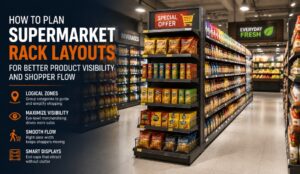
For better planning, your supermarket rack layout should match your product categories, customer movement, and available floor space.
Common Mistakes in Retail Fixture Planning
Retail fixture mistakes can affect both customer experience and product sales. Many problems happen because store owners choose racks before planning the layout properly.
Common mistakes include:
- Choosing racks before understanding shopper flow
- Using too many tall fixtures in a small store
- Making aisles too narrow
- Placing island displays where they block movement
- Not considering product weight
- Not grouping product categories clearly
- Ignoring customer eye level
- Underestimating future stock expansion
- Buying fixtures that do not match the store layout
- Placing promotional displays in low-visibility areas
- Leaving dead zones where customers rarely browse
One common mistake is overfilling the store. More shelving does not always mean better sales. If customers cannot move comfortably, browse easily, or find products clearly, the store may feel crowded and difficult to shop.
Another mistake is ignoring product weight. Hardware items, bottled products, and heavy packaged goods need suitable shelving strength. Choosing the wrong fixture can create safety and durability issues later.
What to Consider Before Choosing Retail Fixtures
Before choosing between gondola racks, wall shelving, and island displays, it is helpful to review your store’s needs carefully.
Consider the following:
- Store size
- Floor plan
- Aisle width
- Product categories
- Product weight
- Product height
- Packaging size
- Stock volume
- Customer flow
- Entrance and exit points
- Checkout location
- Promotional areas
- Visibility from key angles
- Future expansion
- Budget
- Installation requirements
You should also think about how customers will move through the store. Which products should they see first? Which aisles should guide them deeper into the shop? Which items should be placed near checkout? Which products need stronger visibility?
Good fixture planning is not only about display capacity. It is also about creating a layout that supports browsing, buying, and store operations.
Ready to Plan Your Retail Shelving Layout?
Choosing between wall shelving, gondola racks, and island displays becomes easier when you understand your store layout, product categories, and customer flow.
Wall shelving helps maximise perimeter space. Gondola racks help create organised aisles. Island displays help highlight promotions and high-visibility products.
If you are planning a minimart, supermarket, pharmacy, hardware store, or retail outlet, choosing the right fixture layout can help improve product visibility, shopper comfort, and store efficiency.
Explore our gondola rack solutions to find suitable retail shelving options for your store layout.
Frequently Asked Questions
What is the difference between wall gondola and island gondola?
A wall gondola is usually single-sided and placed against a wall. An island gondola is usually double-sided and placed in the centre of the store so shoppers can browse from both sides.
Is a gondola rack suitable for minimarts?
Yes. Gondola racks are commonly used in minimarts because they help organise products, create aisles, and maximise display space. They are suitable for snacks, groceries, household items, personal care products, and general retail merchandise.
Which is better for small stores: wall shelving or island display?
Wall shelving is usually better for saving floor space because it uses the perimeter walls. Island displays are useful only if the store has enough open space for centre displays or promotions.
Can supermarkets use both wall shelving and island gondola racks?
Yes. Supermarkets commonly use a combination of wall shelving for perimeter displays and island gondola racks for centre aisles. This helps create clear product zones and organised shopper flow.
What should I consider before buying supermarket racks?
Before buying supermarket racks, consider store size, aisle width, product weight, product categories, customer flow, display height, and whether the fixtures need to support promotions or future expansion.
Are island displays only for promotions?
No. Island displays are often used for promotions, but they can also display fast-moving products, seasonal items, new arrivals, or high-visibility product categories.
How do I know which retail shelving layout is best?
The best layout depends on your store size, product range, customer movement, and display goals. A combination of wall shelving, gondola racks, and selected island displays usually works better than relying on only one fixture type.