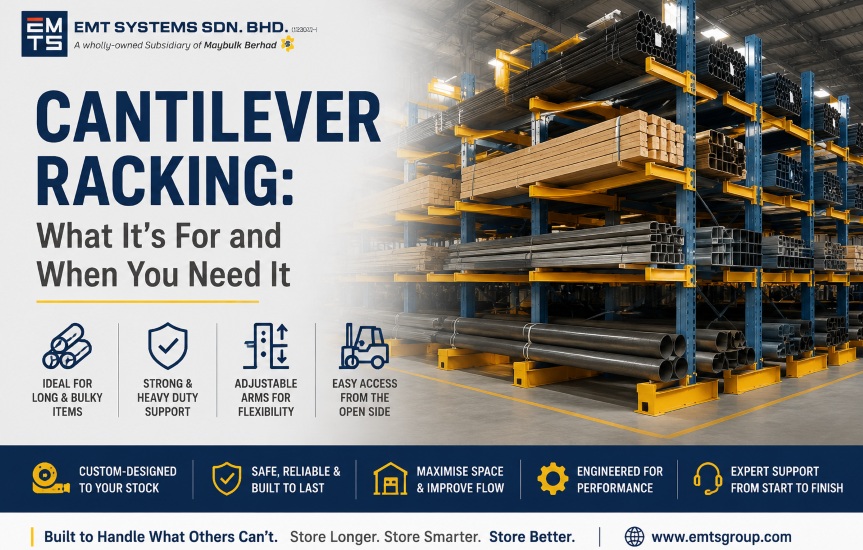
If you’re storing pipes, timber, steel bars, furniture, or anything else that’s long and awkward to shelve, standard pallet racking probably isn’t the right fit. This is exactly the gap cantilever racking fills. Instead of shelves or decking, it uses horizontal arms extending out from a vertical column, giving you an open structure built specifically to hold long and bulky items that don’t fit neatly onto a pallet or into a frame.
What Is Cantilever Racking?
Cantilever racking is built from a series of vertical steel columns, each fitted with arms that extend outward to support the load. There are no front uprights blocking access, so you can load and unload items from the open side without sliding them between support posts, as you would with standard shelving.
Arm heights are usually adjustable, so the system can be reconfigured as your stock changes, and arms come in different lengths depending on how far the load needs to be supported. The result is a system that’s much better suited to oddly shaped, lengthy, or heavy materials than almost any other racking type.
What Cantilever Racking Is Used For
Cantilever racking is the standard choice across several industries where the products themselves don’t fit standard storage formats:
- Timber and lumber yards use it to store long boards and beams without causing them to bend or warp.
- Steel and metal fabrication businesses rely on it for bars, tubing, and structural steel sections.
- Plumbing and building supply businesses use it for pipes and conduit of varying lengths.
- Furniture manufacturers and showrooms use it to store finished pieces and long components.
- Carpet and flooring suppliers often use it for rolled goods that need horizontal support along their length.
In short, if an item is long, heavy, or an awkward shape that doesn’t sit well on a flat shelf or pallet, cantilever racking is usually the answer.
Single-Sided vs Double-Sided Cantilever Racking
Cantilever systems come in two main configurations.
Single-sided cantilever racking has arms extending from one side of the column only. It’s typically used against a wall or where access is only needed from one direction.
Double-sided cantilever racking extends arms from both sides of the same column line, allowing access from either side. This makes more efficient use of floor space in open warehouse areas where loading and unloading can happen from both directions.
Light Duty vs Heavy Duty Cantilever Racking
Like most racking systems, cantilever racks come in a range of capacities. Light-duty cantilever racks suit smaller items such as PVC pipe, light timber, or smaller furniture components. Heavy-duty cantilever systems are built with thicker steel columns and reinforced arms to handle structural steel, large timber sections, or heavy metal stock. The right capacity depends on both the weight of individual items and the total load each arm and column must support across the full bay.
Advantages of Cantilever Racking
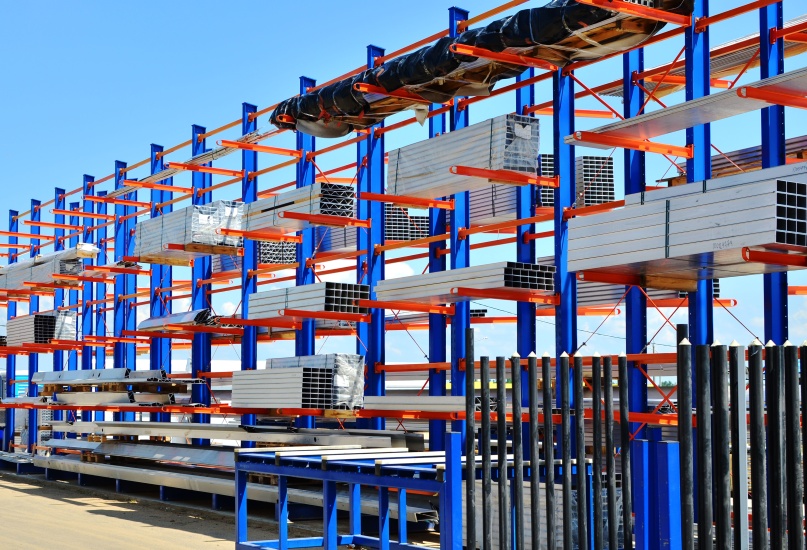
The open front design is the biggest advantage. Without front columns in the way, loading and unloading long items is far easier, and there’s no risk of items getting caught or damaged against support posts during handling.
Adjustable arm heights mean the system can adapt as your stock profile changes, rather than locking you into a fixed configuration. And because arms can be specified at different lengths, a single system can often handle a wide range of item sizes rather than needing several different storage solutions.
Things to Consider Before Choosing Cantilever Racking
Cantilever racking generally needs more horizontal floor space than other racking types, since the arms extend outward rather than stacking items vertically within a frame. If your warehouse is tight on floor space, this is worth factoring into your layout planning early.
Installation is also more involved than standard shelving or boltless racking, since column spacing, arm length, and load distribution all need to be planned around your actual stock rather than assembled from a generic kit. This is one of the reasons cantilever projects tend to be custom-designed rather than off-the-shelf. If you’re weighing this against other racking formats more broadly, our breakdown of different pallet racking types covers how cantilever stacks up against options like selective and drive-in racking for various storage needs.
Maintenance is another factor worth planning for. Because of its open structure and the way loads are distributed across its extended arms, repairing a damaged cantilever system often requires specialised equipment, such as an engineered rack-lifting jack, rather than a standard repair kit. Our guide on repairing, replacing, or upgrading a warehouse racking system goes into more detail on when repair makes sense versus when replacement is the safer option.
Is Cantilever Racking Right for Your Business?
Cantilever racking is worth considering if any of the following sound familiar:
- You’re currently storing long items horizontally on the floor, which takes up space and creates a trip hazard.
- Your inventory includes pipes, timber, steel bars, or similarly shaped materials that don’t fit pallet racking or standard shelving.
- You need to load and unload from an open side rather than navigating between support posts.
- Your stock sizes vary enough that a fixed shelf configuration doesn’t really work.
- If none of these applies and you’re mostly storing palletised goods or boxed inventory, a standard pallet racking system is likely the better and more space-efficient fit.
Why Choose EMTS for Cantilever Racking
EMTS designs cantilever systems around your actual stock profile rather than offering a one-size-fits-all configuration. Our team will assess the length, weight, and shape of what you’re storing, then specify column spacing, arm length, and load capacity to match, with installation and aftermarket support handled as part of the same project.
Get a Cantilever Racking System Built Around Your Stock
If standard shelving and pallet racking aren’t cutting it for your long or bulky inventory, EMTS can design a cantilever system suited to exactly what you’re storing. Explore Our Cantilever Racking Range
Frequently Asked Questions
What items are best suited to cantilever racking?
Long, bulky, or irregularly shaped items that don’t fit standard pallets or shelving, such as pipes, timber, steel bars, structural sections, and rolled materials like carpet.
How is cantilever racking different from pallet racking?
Pallet racking is designed around standard pallet sizes stored on shelves or beams within a frame. Cantilever racking has no front structure at all, using extended arms instead, which makes it better suited to items too long or oddly shaped for a pallet.
Can cantilever racking be used outdoors?
Yes, outdoor cantilever systems are common for storing timber, pipes, and steel stock in yards, though the structure needs to be specified for outdoor conditions from the start.
Is cantilever racking more expensive than standard racking?
Cantilever systems are generally custom-designed around your specific stock, so pricing depends on column height, arm length, load capacity, and quantity rather than a fixed standard cost. A tailored quote is the most accurate way to know what your specific setup will cost.
Can cantilever racking be adjusted after installation?
In most cases, yes. Arm heights can typically be repositioned on the column to accommodate changes in stock size, though major changes to arm length or load capacity usually require professional reassessment.