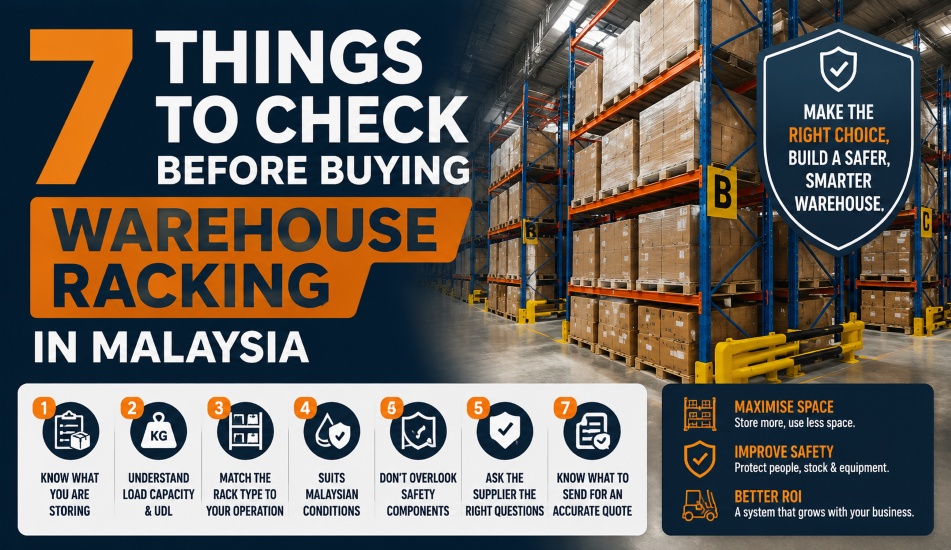
Buying a warehouse racking system is a bigger decision than it first appears. The right choice keeps your stock accessible, your workers safe, and your floor space working as hard as it can. The wrong one leads to wasted space, damaged goods, safety risks, and the cost of replacing a system that never fit your operation.
Here are seven things to check before you commit, written for Malaysian operations where humidity, safety expectations, and building constraints all shape the right decision.
1. Start With What You Are Storing, Not the Rack
The most common mistake is choosing a rack type before understanding the load. Every good racking decision starts with the product.
Before you speak to a supplier, gather:
- Heaviest pallet weight, including packaging. Not the average, the heaviest.
- Pallet dimensions and type, whether standard, euro, or custom
- Number of pallet positions you need now, plus a realistic estimate for growth
- SKU count and picking frequency, meaning how often stock moves in and out
- Clear ceiling height and any obstructions such as beams, sprinklers, or lighting
A system designed around average pallet weight can become unsafe the moment your heaviest loads go in. Your quote should reflect real load data, not rough estimates.
2. Understand Load Capacity and UDL
Load capacity is the most important safety factor in any racking system, and it is where cheaper systems quietly cut corners.
Racking load is usually expressed as UDL, or Uniformly Distributed Load. This is the maximum weight a beam level can safely hold when the weight is spread evenly. A beam rated at 2,500kg UDL is designed to carry that load when pallets sit evenly across it, not concentrated in one spot.
Two things to check:
- The total rack rating is only as strong as its weakest part. Damage to a single upright or beam reduces the integrity of the whole system.
- Ask for the UDL load tables. A reputable Malaysian manufacturer publishes UDL ratings for different beam lengths and upright configurations. If a supplier cannot show you these, treat it as a warning sign.
For a fuller explanation of how to match rack design to pallet weight, our heavy-duty rack load capacity guide works through the calculations in detail.
3. Match the Rack Type to How Your Warehouse Runs
There is no single best racking system, only the one that fits your operation. The right configuration depends on how you balance storage density against access.
- Selective pallet racking gives direct access to every pallet. It is the simplest and most flexible choice, ideal for operations with many SKUs and frequent picking.
- Double deep racking stores two pallets deep, increasing density but requiring deep-reach forklifts.
- VNA racking uses very narrow aisles to maximise floor space and height, with specialised trucks. It is increasingly popular in Malaysia where floor space is expensive.
- Drive-in racking offers very high density for bulk storage of low-SKU-variety stock.
Choosing between these becomes easier once you know your pallet profile and picking pattern. Our guide on selecting the right warehouse racking system compares them side by side.
4. Check the System Suits Malaysian Conditions
This is where global buying guides fall short, and local operations get caught out.
- Humidity and corrosion. Malaysia’s climate is hard on steel. Ask about protective coatings and finishes, especially for damp environments, cold storage, or facilities near the coast. Galvanised or properly powder-coated steel resists rust far better over time.
- Flood-prone areas. If your location carries any flood risk, stable bases and corrosion-resistant construction matter more, not less.
- Local safety expectations. Warehouse racking should be installed and loaded in line with recognised safety practice. Load signage, proper aisle widths, and rack protection are not optional extras. They protect both your people and your stock.
5. Do Not Overlook Safety Components
The rack frame is only part of a safe system. When comparing quotes, check what safety components are included rather than added later at extra cost:
- Rack guards and column protectors to absorb forklift impact
- Safety netting or mesh where pallets could fall into walkways
- Beam locks to prevent accidental dislodging
- Load notice plates showing the rated capacity of each bay
A quote that leaves these out may look cheaper, but the cost reappears the moment you add them.
6. Ask the Supplier the Right Questions
Selecting a racking supplier involves more than comparing prices. Before you commit, ask:
- Can you show me your UDL load tables for the beams you are quoting?
- Is the steel finish suitable for my warehouse environment?
- Are safety components included in this quote, or priced separately?
- Do you handle delivery and installation, or is that arranged separately?
- Can the system be expanded or reconfigured as we grow?
- Do you manufacture the racking yourselves, or resell it?
That last question matters. Buying from a manufacturer rather than a reseller usually means better pricing, direct customisation, and a single point of accountability if anything needs adjusting.
7. Know What to Send for an Accurate Quote
To get a quote built around your operation rather than a generic estimate, send your supplier:
- Pallet dimensions and heaviest pallet weight
- Number of pallet positions required
- Forklift type and clear ceiling height
- Photos of the space, and of any existing racking
- Project timing, and notes on any old rack that needs removal
The more accurate your information, the more accurate and safer the system you receive.
Making the Right Choice
Buying warehouse racking comes down to matching load, access, and site conditions to a system built for your operation, from a supplier who can stand behind it. Get the inputs right, and you get years of safe, efficient storage. Get them wrong, and you pay to fix it.
As a Malaysian racking manufacturer, EMT Systems helps warehouse operators specify systems around their real pallet profile, SKU flow, and site conditions rather than off-the-shelf guesses. If you are planning a new system, an upgrade, or a reconfiguration, talk to our team, and we will help you get the specification right from the start.
Frequently Asked Questions
How do I know what load capacity I need?
Start with your heaviest pallet, add a safety margin of 10 to 15 per cent for forklift handling, and compare it against the supplier’s UDL load tables. Never plan around average weight alone.
Should I buy from a manufacturer or a reseller?
A manufacturer typically offers better pricing, direct customisation, and clearer accountability, because there is no middleman between you and the people who build the rack.
What racking type is best for a warehouse with limited floor space?
VNA racking maximises height and density in narrow aisles, though it needs specialised forklifts. Double deep is another space-saving option for lower-SKU operations.
Does racking need special treatment for Malaysia’s climate?
Yes. Humidity accelerates corrosion, so galvanised or properly powder-coated finishes are worth specifying, particularly for cold storage, coastal sites, or damp environments.
What information should I give a supplier for a quote?
Pallet dimensions and weight, number of positions needed, forklift type, clear height, photos of the space, and project timing. Accurate inputs produce accurate, safe quotes.