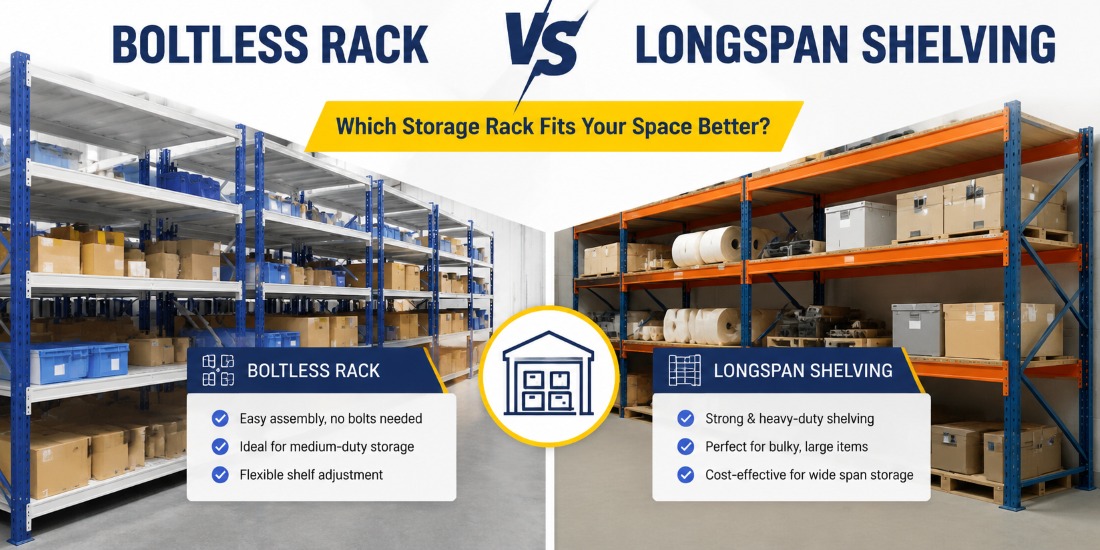
Boltless racks and longspan shelving often get compared as if they’re two completely different systems, but they’re closer relatives than most buyers realise. Both are typically tool-free, assembled with a rubber mallet rather than with nuts and bolts, and designed for hand-loaded storage rather than forklift pallet handling. The real difference is capacity and span. Longspan shelving is best thought of as the heavier-duty end of the boltless family, built with thicker steel and longer beams to carry more weight across a wider shelf. Understanding where standard boltless racking tops out and where longspan racking picks up is key to choosing the right one for your space.
What Boltless Racks Are Best For
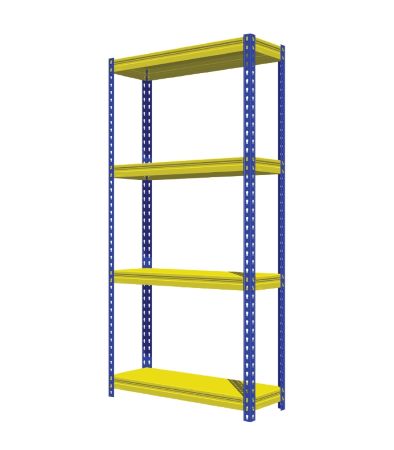
Boltless racks are the go-to choice for light-to-medium storage needs where assembly speed and flexibility matter more than raw capacity. They’re built from steel uprights and shelves that click or rivet into place, with no nuts, bolts, or screws required.
Boltless racking works well for:
- Office archives and document storage
- Storerooms and back-of-house stock areas
- Retail backroom storage
- Light parts and tool storage in workshops
- Any space where shelving needs to be reconfigured or relocated often
Because they’re lighter-duty by design, boltless racks are also generally more affordable and easier to fit into smaller or irregularly shaped spaces.
What Longspan Shelving Is Best For
Longspan shelving uses the same general tool-free assembly principle as boltless racking, but with a heavier-gauge steel frame, a longer beam span, and full-width decking built to carry bulkier, heavier loads. It’s the better choice when you’re storing items that are too large or too heavy for standard boltless shelves to handle comfortably.
Longspan shelving is well-suited to:
- Carton and box storage in warehouses
- Spare parts and mixed-SKU inventory
- Manual picking environments where forklift access isn’t needed
- Retail and automotive workshop storage of bulkier stock
- Warehouses that need fewer uprights to cover more storage area per bay
Because longspan shelving doesn’t always require a bottom beam, it can also support ground-level storage of bulkier items alongside the shelving above, something standard boltless racks aren’t typically built for.
Load Capacity and Span Differences
This is where the two systems really separate. Boltless racks are designed for lighter, evenly distributed loads, think files, small parts, or stacked cartons within a standard shelf depth. Longspan shelving is engineered for heavier point loads distributed across a longer beam, which allows it to handle bulkier cartons and parts without needing additional uprights every shelf width.
As a rough rule of thumb: if what you’re storing is starting to feel heavy for a standard shelf, or you need a single shelf to span a wider gap without an extra support post in the middle, you’ve likely outgrown boltless and are looking at longspan territory.
Assembly and Adjustment Differences
Both systems are designed for tool-free assembly, which is one of the main reasons buyers group them together in the first place. The practical difference shows up in the build itself: boltless racks are lighter to handle during assembly and quicker to reconfigure, since the components themselves are smaller and easier to manoeuvre. Longspan shelving’s heavier steel and longer beams mean assembly still doesn’t require bolts or screws, but the components are bulkier to position, and reconfiguring a longspan bay is a slightly bigger job than adjusting a boltless shelf height.
Both systems can typically be disassembled and relocated if you move premises or reconfigure your space, a genuine advantage over fixed bolted shelving for either option.
Best Use Cases by Environment
- Office storage: Boltless racking is almost always the right fit here. Document storage and office supplies rarely need long-span-level capacity.
- Retail backroom: Boltless racks suit most backroom stock, though stores handling bulkier inventory (large appliances, bulk packaging) may benefit from longspan in specific areas.
- Storeroom / light warehouse: Either can work depending on what’s being stored; this is the zone where it’s most worth checking actual item weight and size before deciding.
- Medium-duty warehouse: Longspan shelving is generally the better fit once you’re storing cartons, spare parts, or mixed inventory at scale, since it covers more storage area with fewer uprights.
Which One Should You Choose?
Rather than treating this as a head-to-head choice, it’s more useful to think of it as a capacity-threshold question: start with what you’re storing and let the weight and size of those items point you toward the right tier.
- If your stock is light, your space is small, and you value quick reconfiguration, boltless racking is almost certainly the right call.
- If your stock is bulkier or heavier than standard boltless shelves can comfortably handle, or you need fewer uprights covering more shelf area, longspan shelving is the next step up.
- If you’re not sure where your storage needs actually fall, that’s exactly the kind of question worth getting an honest answer to before you buy, rather than guessing and having to upgrade later.
Not Sure Which Fits Your Space?
Both boltless racks and longspan shelving are part of our core product range, and our team can help you determine which one or which combination best fits your storage needs, space, and budget.